
Local & Community History Month: What was the relationship between the owners of Middleton Hall and St John’s Church in Middleton village?
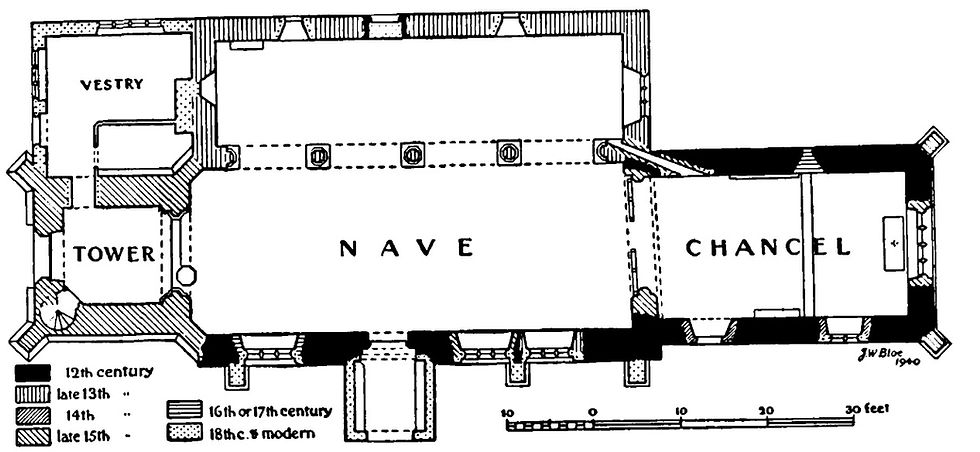
In the Domesday Book of 1086, it was recorded that a church was present at Middleton. However, the Church present today is believed to have been initially constructed in the 12th century. This was when the Middleton Estate was in the possession of the de Marmion family. They additionally had the advowson of St John’s Church at Middleton. An advowson enabled someone to propose who would hold the ecclesiastical position at a specific church. Advowsons recognised the role of the holder as “patron” of the church and aimed to protect the rights of the landowner who had built or endowed the church. Hence, all of the early construction can be assumed to have been built by the owner of Middleton Hall.
However, in 1257, Philip de Marmion, 5th Baron Marmion of Tamworth, granted the advowson of St John’s Church at Middleton to St Editha’s Collegiate Church in Tamworth. At that time, St Editha’s also gained full possession of the Vicarage at Middleton. Furthermore, at some point after 1259, Philip additionally granted the entirety of the manor of Middleton to St Editha’s. A specific clause in that grant stated that Philip and his rightful heirs were to remain as sub-tenants-in-chief at Middleton forever. However, they would also be required to make a specified annual “donation” at the Church’s altar on St Editha’s Day every year, which was the 15th July. After this time, it is known that the income from the Middleton owners and the Middleton Estate was one of the greatest sources of income that St Editha’s Church received. As a result of this grant, all of Middleton was taken out of the control of the King as the ultimate feudal lord because it became Church land.
Therefore, from this time, it is uncertain whether the work undertaken at St John’s was done by the owner of Middleton Hall or by St Editha’s, but both churches and the owner of Middleton were tightly bound together.
A document in the Middleton Collection confirms that Sir Henry Willoughby undertook work on St John’s. In an indenture dated 1507, made between Sir Henry and Thomas Bowde, Dean of St Editha’s, Sir Henry was excused from paying what he was bonded to pay as his annual donation for three years. Sir Henry promised that, in return, he would build and repair the chancel of St John’s to a sufficient quality. Specifically, he would build and repair the walls with new stone, set a new timber roof upon them with new lead and then glass the windows. The history of St John’s gives a similar date for the construction of the west tower, the carved archway towards the nave and the addition of clerestories above not only the chancel but also the nave.
This relationship continued until 1548, which was when the Crown took possession of St Editha’s Church and all its land in the Reformation. The manor of Middleton essentially reverted back to the feudal structure it had before Philip’s second grant. However, St John’s Church and the Vicarage then became a direct possession of the Crown.
St John’s Church thus became classified as a peculiar (outside diocese jurisdiction), at least for a time. After the Interregnum (1649-1660), the advowson appears to have returned to the nominal owner of Middleton Hall (the owner if it was not under dower possession). The first person who is known to have regained possession, and was described as patron once again, was Francis Willughby F.R.S. in 1668. This patronage continued to be held by the owner of the manor until at least 1920. However, by 1926, the patronage of St John’s Church had changed to the Bishop of Birmingham.
In 1569, it is known that the Vicarage was being leased by George Fox alias Willoughby, the illegitimate brother of Sir Francis I Willoughby, for a term of 21 years. However, in 1577, Queen Elizabeth I leased it to someone else and it then passed through various hands. It is uncertain when but, by 1775, it had returned to the full possession of Thomas Willoughby, 4th Lord Middleton. The Vicarage continued to be owned by the owner of Middleton until it was sold at the 1924 auction of the Middleton Estate.
Further Reading: L. F. Salzman (ed.), "Middleton", A History of the County of Warwick: Volume 4, 1947.
Author - Debbie Jordan, Middleton Hall Volunteer.


Comments