
1676 Inventory of Middleton Hall #20: The Larders
This post, the twentieth in the series detailing the rooms and contents of Middleton Hall as described in the 1676 inventory, focuses on the larders. These were specifically named as “The Old Larder”, “The West Larder” and “The New Larder”.
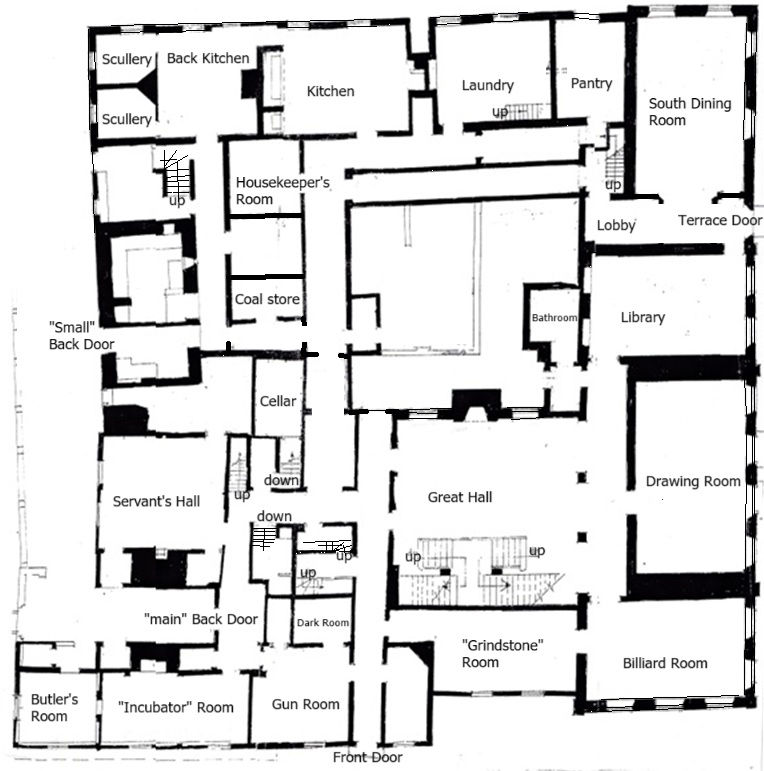
In the 1924 auction catalogue of Middleton Hall, there were still only three larders listed, but it is uncertain where these were. There was a suggestion that two may have been located in the small ground floor rooms created on the north and south side of the chimney breast, between what is today the Old Kitchen and the Tea Room. It is known that both of these small rooms were accessed from external doors.
Traditionally, larders were where raw meat was salted and stored. The rooms would have been situated in cool areas and they often had a small window that was covered with gauze to allow the passage of cool air in but no insects. It was only in the 19th century that they began to be divided by their specific usage, such as fish, game, dry (pantry) and wet (butchery).
Although the inventory is a useful illustration of the household at Middleton Hall, because the house was closed, when considering the items a caveat must be taken into account. This is that many items listed in the inventory are not in their proper place and were simply being stored in the room instead. The Old Larder definitely appears to have been used for general storage rather than its proper function. The items listed there were:
Two wooden pasty plates. As noted in the previous post on the Kitchen, these were plates specifically designed to serve pasties.
A hundredweight jack weight of lead and another of stone. In the same previous post, it was noted that there was a roasting jack device to turn the spit in the Kitchen. These would have been the weights for that device. The equivalent of an English hundredweight was 112lbs or about 50kg.
One chopping block. This would likely have simply been a thick section of a hardwood tree trunk, normally elm, that was used for butchery.
One sauce tub. This would have been a small wooden tub or cask that would have held fermenting pickling liquor, brine, verjuice or other prepared sauces.
One tin safe. This would have been an expensive tin-plated lockable food storage box used for the safekeeping of perishable and valuable food items. At this time, tin-plate was still a luxury imported material.
Two wire mole traps. These early mole traps would have had spring-loaded wire loops anchored to wooden pegs and would have been used by the Estate gardener to catch moles.
One cup that was used to wash feet. This would have been a large, deep ceramic or wooden basin. In this era, whole-body bathing was rare but washing feet in a dedicated basin daily was a common practice.
Three brass pans for ashes. These were deep brass pans that were used to clean out wood ash from the hearths.
Two old joint stools. As explained in the previous post on John Ray’s Chamber, a joint stool was one jointed together rather than glued or nailed.
One Jersey spinning wheel. This was also known as a Great Wheel. It featured a massive drive wheel that was often up to 60 inches across (152cm) and was a single spindle device. This was used for spinning combed wool yarn. The operator would use it standing, turning the wheel with their right hand and drawing the wool in their left.
Two spinning wheels for spinning linen. These were smaller spinning wheels that were also known as Saxony or Castle Wheels depending upon whether they were horizontal or vertical. They were treadle foot-powered and thus would be operated seated. Additionally, they were equipped with a flyer and bobbin mechanism and a distaff. These wheels were specifically engineered to be able to wet-spin flax into linen thread.
Two more spinning wheels, one Goodwife Messon’s and the other Nan Sheppard’s. Goodwife was a polite form of address used in about the 16th and 17th centuries for a married woman who belonged to the layer of society just below the gentry, specifically the yeoman or working class who were freeholders. It would never be used for someone who did not have property. The title was often shortened to “Goody”.

The items in the West Larder suggests that it was being used for its proper purpose of raw meat storage. The items listed were:
A tub to keep salt in.
A powdering tub. This was a large wooden barrel in which meat was heavily powdered with salt to brine it in order to preserve it.
A kimnel. This was a shallow, wide wooden tub made in the same manner as a cooper did a barrel. Depending on where it was located, it could have been used for tasks such as salting bacon, cooling brewed beer or kneading dough.
A pair of great scales. These would have been large balance scales used to weigh heavy provisions, such as salted meat.
A hair cloth. This was a coarse sheet of woven horsehair that would have been used as a heavy strainer or for something to dry malted grain on.
Finally, the New Larder, which although having a number of food related items in, appears to have also been used more for storage of important items rather than its proper purpose at this time. The items listed in this room were one cupboard, nine knives and:
One marble mortar and pestle. Two further mortar and pestles were recorded in the previous post on the Kitchen, but they were of different materials. This marble one, as a non-porous material, would normally be specifically used for either wet pastes or ingredients that might absorb flavours or react badly to metals, such as certain items for medicinal powders.
One flour bin. This was a heavy wooden chest with a sloped lid that was used to keep flour dry and safe from pests.
Two large and two lesser gallipots and two more gallipots for pickles. These were small earthenware or tin-glazed Delftware jars that were used for storing preserves, pickled food, ointments or medicines.
Lead weights, three great and five lesser. These would have been used on scales.
Two white basins and one white plate. These are likely to have been tin-glazed earthenware known as Delftware, which, as was noted in the previous post on the Queen’s Chamber, had a striking glossy milk-white finish and mimicked porcelain.
Two flint glasses. These referred to crystal glasses, known as English flint glasses. They were produced by George Ravenscroft’s method, which was patented in 1674, to mimic cristallo glass from Venice. This patent established him as the sole manufacturer of flint glasses. He used ground-up riverbed flint stones as his source of silica, which gave the glass its name. His early efforts had suffered from the problem of internal cracking, known as crizzling, and he resolved this about a year later by adding lead oxide. The resulting glass vessel was heavy, durable and refracted light like crystal. Ravenscroft closed his flint glass manufacturing business in 1679 and his patent expired in 1681. At the time of this inventory, these would have been incredibly expensive and at the height of cutting-edge luxury, fashion and technology in England.
One lock and key for the garden bridge. It is uncertain what bridge and what garden this refers to. There is no other reference to a “garden bridge”. There are two primary possibilities for the bridge: a bridge specifically leading to the gardens that crossed over the moat; or a bridge over the water-filled ditch that encircled the large Kitchen Garden to the south-east of Middleton Hall. However, the 1702 deed of Middleton Hall, specifically stated that there were 10 gardens at Middleton Hall and that would probably have been the same in 1676.

Author - Debbie Jordan, Middleton Hall Volunteer.


Comments