
The Averill Renovation of Middleton Hall
Middleton Hall’s continually evolving form is one of its unique architectural characteristics and a large part of the form that it has today is due to John Averill’s Renovation. This Renovation began soon after John Averill, a farmer and industrialist, and his family took up residence at Middleton Hall. Although John had purchased Middleton Hall at auction in December 1924, the purchase did not immediately evict the existing tenant and thus John did not take up immediate residence. However, the tenant, Egbert de Hamel, died on 24th January of 1925. The auction for the sale of Egbert’s possessions at Middleton Hall concluded on 27th March 1925 and it is believed that it was soon after this that John Averill and his family began their residence and renovation of Middleton Hall.
The Averill Renovation was one of the rare total renovations of Middleton Hall and significantly changed the structure and appearance of the Hall. His changes can be summarised as: converting the Jettied Building, John Ray Building and part of the South Wing into stand-alone cottages that were then leased; retaining (with modifications) the remainder of the South Wing, West Wing and Great Hall as his family home; and the demolition of the central structures. However, the best way to explain the impact of Averill’s Renovation is not through words but through two plan maps, one before his renovation and one after.
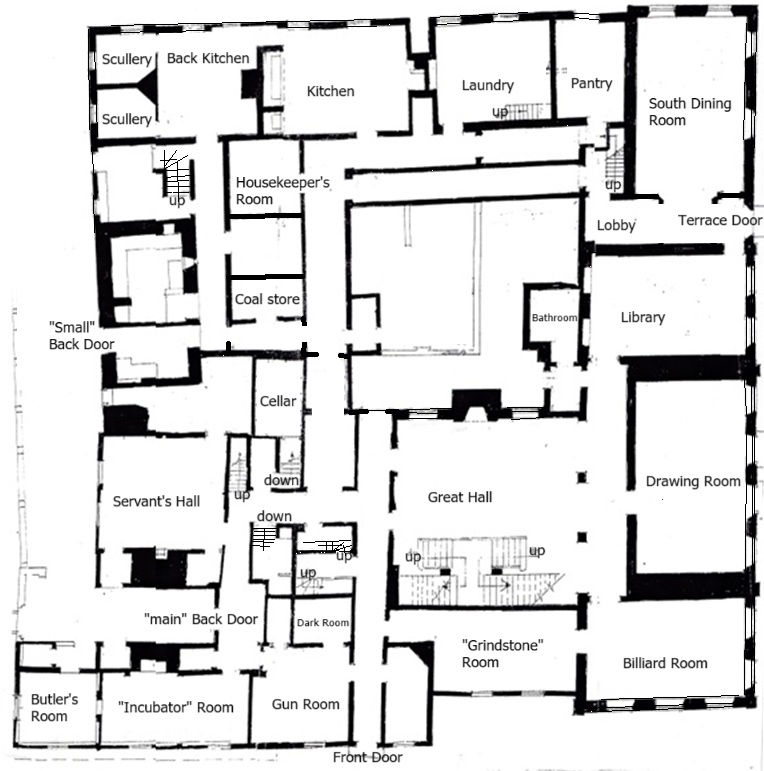

A lot of the deterioration that Middleton Hall subsequently suffered can be traced to the construction techniques and materials that Averill used. In particular, he encased many of the timber-framed buildings in brick and widely used concrete plaster. However, the damaging nature of these materials on the old structures of Middleton Hall would not have been known in his time. Moreover, the 1924 Middleton Estate auction catalogue had also incorrectly stated that all of the structures of Middleton Hall were made of brick. The techniques Averill used would have been suitable if that had been true.

It was stated that the central buildings were demolished because Averill desired greater vehicular access. At this point it should be noted that Listed Building status did not exist when he undertook this work. Therefore, if he had wanted to, he could have legally demolished Middleton Hall. Furthermore, this was the time of the Great Depression and many similar stately homes that were purchased around this time were demolished. Therefore, it is necessary to credit Averill with at least not demolishing Middleton Hall entirely and also enabling it to remain a functional home.

The greatest architectural heritage loss from Averill’s Renovation was the 14th century Chapel that had stood at the north front of Middleton Hall. However, Middleton Hall Trust were told by an eye witness to its demolition that it was not what Averill had actually intended. He said that Averill had wanted to convert the building into a covered archway, just like the one in the Tudor Barn. However, that was an integral feature. Therefore, it will not come as a great surprise to many that when Averill knocked down the lower half of the Chapel, the upper half of this timber structure fell down too. Our eye witness told us that the roof remained in place for about three months before it also collapsed.
Author - Debbie Jordan, Middleton Hall Volunteer.


Comments