
VE Day: Anderson Shelters
To mark the anniversary of VE Day, this post will focus on the Anderson Shelters that were constructed at Middleton Hall during the Second World War. In the 1850s the moat had been drained from the north bridge, which created a dry moat. The Anderson Shelters were constructed in the northern part of this dry moat channel.
Anderson Shelters were invented in 1939 by William Patterson. He was an engineer who was tasked by Sir John Anderson to develop a small cheap bomb shelter. Sir John was in charge of Air Raid Precautions. The most common form of the Shelters could accommodate six people and was constructed of six curved sheets of corrugated steel that were bolted together at the top and had eight flat steel plates for the sides. They measured 6 feet high (1.95m), 4½ feet wide (1.35m) and 6½ feet long (2m). Earth was then heaped on top of the shelter and against the front door side. Corrugated steel was used because it provided strength against the compressive force from a bomb blast.
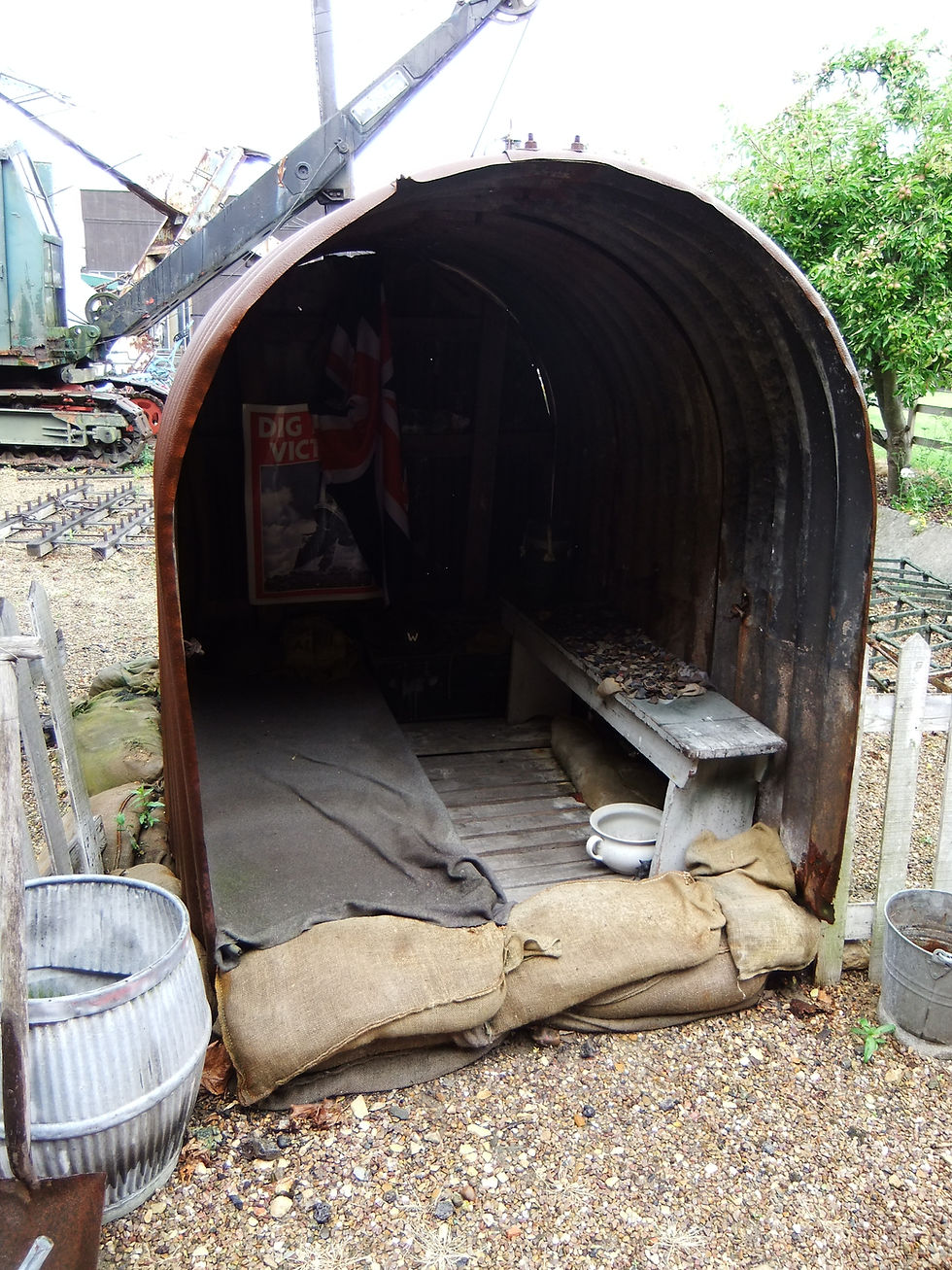
There was a larger version of the Shelters that could accommodate 10 people. However, more than one of those would have been required at Middleton Hall to house just the people living within the confines of the moat. The 1939 Register records that at Middleton Hall itself the residents consisted of John and Jessie Averill and their son Frederick, who was noted to be a Civil Air Guard. Then there were also the residents of the Middleton Hall Cottages, which had been constructed by John Averill in the 1920s from parts of Middleton Hall specifically the Jettied Building, the John Ray Building and the eastern end of the South Wing. In the first cottage was the Dixon family of Charles and Edith and their four children. In the second cottage was Arthur and May White and in the third cottage was John and Lilian Tarver and their daughter Muriel. Furthermore, numerous evacuees and their teachers, we believe from Birmingham, are known to have also resided at Middleton Hall. Testimonies have reported that they slept in the Great Hall.
One of the children of Charles and Edith Dixon gave testimony to Middleton Hall Trust that she remembered being able to see the sky lit up from Middleton by the fires caused by bombs dropped on Birmingham. The German bombers would fly over Middleton on their return and she remembered their sound. In hindsight, she commented that the construction of the Anderson Shelters in the dry moat was probably not the best idea, because they possibly had a higher chance of dying by drowning than by a bomb. This was because if one of the bombers had dropped a bomb on the dam of Middleton Pool or even if it had just rained very heavily, because the moat had a tendency to quickly re-flood itself in heavy rain as it still does today, they would probably have drowned.
Author - Debbie Jordan, Middleton Hall Volunteer.


Comments