
World Sparrow Day: The House Sparrow
The 20th March 2026 is World Sparrow Day. To mark this, as well as the 350th anniversary of the year of the publication of Francis Willughby’s Ornithologia, this post will focus on part of the description of the House Sparrow provided in Ornithologia. World Sparrow Day aims to raise awareness of the declining population of the House Sparrow, which has declined by over 60% since the 1970s in the UK and has faced a similar decline worldwide in the same time period. The cause of the decline is currently undetermined.
In Ornithologia, the names that Willughby used for birds are frequently not the name they are currently known as. However, in this case he knew this bird by the common English name of the House Sparrow and the Latin name of Passer domesticus. In 1758, when Linnaeus established the binomial taxonomical system, he changed the official name to Fringilla domestica. However, the official name was returned to Passer domesticus in 1769 when the French zoologist Mathurin Brisson introduced the genus Passer. Passer domesticus remains as the official name of this species.
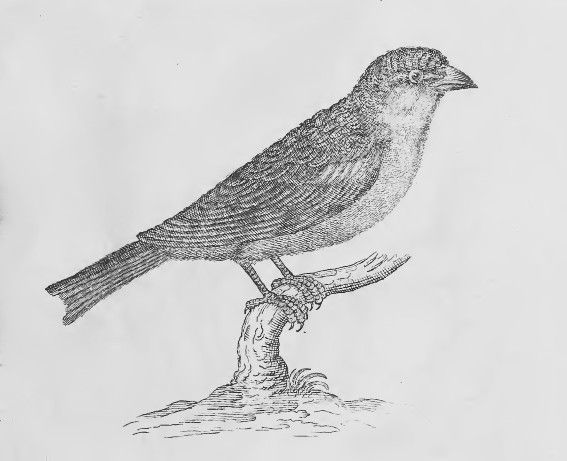
Willughby described that the House Sparrow was a well-known and everywhere-obvious bird. The one they examined weighed one and one-eighth ounces (about 31.9g) and, from the beginning of the bill to the end of its tail, measured 6½ inches (about 16.51cm).
The bill was thick and scarcely half an inch long (about 1.27cm). In the male it was black and in the female it was dusky. The eyes were a hazel colour. The legs and feet were a dusky-flesh colour and the claws were black.
Each wing had 18 flight feathers, which were a dusky colour with reddish edges. From the alula, a broad white line extended to the next joint. Above that line, the covert feathers of the wings were a spadiceous colour and beneath the middle part was black and the exterior edges were red. It was explained in Ornithologia that the colour “spadiceous” was close to a chestnut colour but redder. The tail had 12 feathers and was 2¼ inches long (about 5.71cm). The middlemost feathers of the tail were shorter than the rest and they were all a dusky-blackish colour with reddish edges.
In the male, the head was of a dusky-blue or ash colour and the chin was black. Above the eyes were two small white spots. There was a broad line of a spadiceous colour from the eyes. The feathers growing around the ears were an ash colour. The throat, below the black spot, was of a white-ash colour. Under the ears, on both sides, was a great white spot. The lower breast and belly were white. The shafts of the feathers that divided the back and neck were red on the outside and black on the inside. Toward their bottoms the red terminated in an off-white colour. The rest of the back and rump feathers were the same colour as that of the Thrush, made up of a mixture of green, dusky, and ash colours.
The female lacked the black spot under the throat and the white spots on the neck and above the eyes. Her head and neck were the same colour as the rump. The underside of the body was a sordid white colour. Instead of a white line across the wings, she had black feathers with pale reddish tips. Willughby commented that, in general, the colours of the feathers all over her body were not as fair nor as lively as that of the male.
Finally, they wrote that the House Sparrow fed upon wheat, barley and other grains.

Further Reading: John Ray, Francis Willughby's Ornithologia, 1678, p.249, T44.
Author - Debbie Jordan, Middleton Hall Volunteer.


Comments