
World Curlew Day: Eurasian Curlew
The 21st April 2026 is World Curlew Day. To mark this, and the 350th anniversary of the publication of Francis Willughby’s Ornithologia, this post will focus on part of the description of the Eurasian Curlew from Ornithologia.
Willughby gave the common English name of this bird as the Curlew, but noted that the males were often called the Jack Curlew. He also provided an alternative name of Numenius sive Arquata. In 1758, Carl Linnaeus gave it the taxonomical binomial name of Scolopax arquata. It received its modern taxonomical name of Numenius arquata when the genus Numenius was introduced in 1760 by Mathurin Brisson.

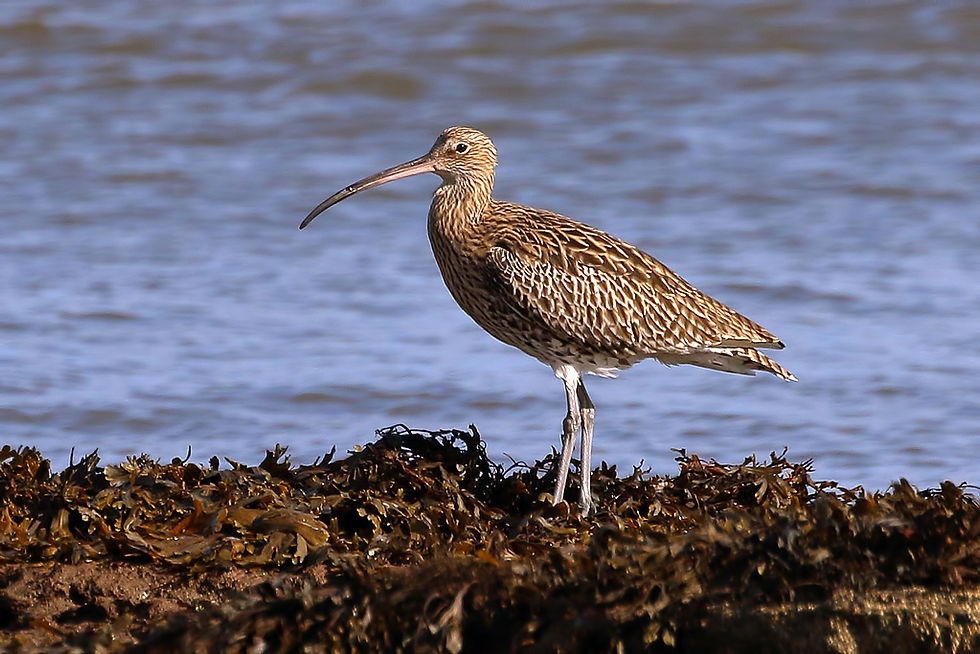
In Ornithologia, it was written that a female they examined weighed 28 ounces (about 793g), whilst a male weighed somewhat less at 25¼ ounces (about 715g). The length of the female from the tip of the bill to the end of the claws was 29 inches (about 73cm) and to the end of the tail was 23½ inches (about 59cm). The wingspan was 40 inches (about 101cm).
Its bill was described as very long. In some of those they measured it was 5½ inches (about 13cm) and in others over 6 inches (about 15cm). It was narrow, bowed, and of a dark brown or black colour. The legs were long, of a dusky blue colour, and bare of feathers half up to the second joint. The claws were small and black.
In Ornithologia, it was described as a seafowl that sought its food on the sands, ooze (the soft mud and silt that accumulates in tidal areas), and salt marshes. It was found on the sea coasts on all sides of England. It ate periwinkle shells.
Whilst all of the above details accurately match the modern description of the Curlew, the description of the feathers provided in Ornithologia do not. This is primarily believed to be because the colour terminology has changed and because the description correlates more with a specific description of the breeding season plumage. In the description in Ornithologia, it was written that the shafts of the feathers of the head, neck, back, breast and throat in the bird they examined were black. The outside parts of the feathers in the head, neck and back were ash coloured with a mixture of red. The edges of the feathers in the breast were white and in the throat were white with a tincture of red. The chin was not spotted. The rump and belly were white and the feathers of the underside of the wing were white. The outermost quill feathers were all black and the rest spotted with white. The first feather of the second row was all black and the tips of the next eighth or ninth were white. It had a small, sharp-pointed, black feather at the end of the wing.
It was also mentioned in Ornithologia, that the Curlew was, for the goodness and delicate taste of its flesh, one of the principal waterfowl to eat. Furthermore, it was commented that the fowlers were not ignorant of that and therefore sold them at an expensive price. A proverb from Suffolk about the Curlew in this context was also included:
A Curlew, be she white, be she black,
She carries twelve pence on her back.
Further Reading: John Ray, Francis Willughby's Ornithologia, 1678, p.294, T54.
Carl Linnaeus, Systema Naturae, 10th edition, p145.
Author - Debbie Jordan, Middleton Hall Volunteer.


Comments